China Tours 2026 – Luxury Small Group Tours of China from Canada
If you are searching for China tours 2026, you’ve just found the right company in Laurus Travel.
As a China tour company with 27 years of experience (since 1998), we have been a top choice among Canadians seeking high-quality China travel experiences. We run our China tours in a small group environment (20 participants maximum) with a strong focus on culture and history. Our guides are simply the best having been carefully screened and tutored by company owners.
You can find lots of reviews on our China tours on Tripadvisor and elsewhere on the Internet. Laurus Travel has been consistently rated A+ by the Better Business Bureau and we are the only Canadian China tour operator recommended by Frommer’s – you can find our name in every edition of Frommer’s China guide.
China Tours 2026 – Recommended Itinerary
26-day China Panorama
Beijing – Xi’an – Chengdu – Lijiang – Xianggelila– Kunming – Chongqing – Yangtze Cruise – Yichang – Wuhan – Guilin – Shanghai
This 26-day journey offers an immersive experience through China’s most iconic cities, the exotic landscapes of Yunnan Province, and a luxurious Yangtze River cruise. Inspired by the National Geographic articles that captivated Western explorers a century ago—and believed to have influenced James Hilton’s Lost Horizon — Yunnan continues to amaze visitors with its breathtaking scenery, rich biodiversity, and vibrant ethnic cultures. From the modern pulse of Beijing and Shanghai to the ancient wonders of Xi’an and the natural splendor of Guilin, this itinerary provides a comprehensive introduction to China.
Reaching altitudes of up to 3,500m (11,500 feet), this adventure is exhilarating yet demanding, and travelers with a history of altitude sickness should take necessary precautions.
Important Features
- Expert local guides hand-picked by company owners
- Small group size – average 15, maximum 20
- Inter-city travel by high-speed train
- No annoying forced shopping stops
- Quality meals at non-tourist restaurants
- Outside cabin on or above bridge deck for Yangtze cruise
- Unlimited supply of bottled water during group activities
- Free Wi-Fi in all hotels
- Day hike at Longji terraced rice fields
- Great Wall visit at Mutianyu with cable car
Options Available
- Peking opera show in Beijing
- Tang Dynasty cultural show with dinner in Xi’an
- Face Mask Changing performance in Chengdu
- Immersive tea farm visit in Guilin
ITINERARY
Meal Code: B = breakfast / L = lunch / D = dinner
Day 1/Thu: Departing for Beijing
The trip starts with your transpacific flight departing from a city of your choice. You’ll lose a day upon crossing the International Date Line.
Day 2/Fri: Arrival in Beijing
Meet the driver on arrival for transfer to the hotel. You’ll have the remainder of the day at leisure. The guide will get in touch with you tonight.
Day 3/Sat: Beijing (B/L/D)
The capital of China, Beijing is a world-class cultural and educational centre. It has a population slightly above of 21 million and ranks behind Shanghai as China’s second largest city. Beijing is renowned for its opulent palaces, temples, and huge stone walls and gates – treasures that make it the most popular tourist city in China by the number of visitors it receives every year.
We begin today with a visit to the Forbidden City. Officially known as the Palace Museum, the Forbidden City was the place where the emperors of the Ming (1368-1644) and Qing (1644-1912) dynasties lived and carried out their administration. Construction of the Forbidden City took 14 years (1406-1420) to complete. The complex consists of 980 buildings and covers 72 hectares or 180 acres. It exemplifies traditional Chinese palatial architecture and has influenced cultural and architectural developments in East Asia and elsewhere. Though the Qing Dynasty was overthrown in 1912, the royal family was allowed to continue to live in the Forbidden City till 1924, when the last emperor, Pu Yi, was driven out of the imperial palace. One year later the Forbidden City was turned into a museum. Declared a World Heritage Site by UNESCO in 1987, this is the largest collection of preserved ancient wooden structures in the world.
Next up is Tian’anmen Square. Located in the heart of Beijing, the square measures 880 metres from north to south and 500 meters from east to west. Said to be the largest public plaza in the world, Tian’anmen Square has the capacity to hold one million people. The imposing Tian’anmen Tower sits at the north end of the square while the Monument to the People’s Heroes dominates the centre. The square is flanked by The Great Hall of the People (west) and the National Museum (east). Chairman Mao’s Mausoleum and Qianmen (Front Gate) are located in the south of the square. One of the top 16 tourist attractions in Beijing, Tian’anmen Square is also the witness of the Chinese people’s great struggles for democracy and personal freedom since 1919.
Afternoon sightseeing takes place at the Temple of Heaven, another UNESCO World Heritage Site. Situated in southeastern Beijing, the Temple of Heaven is China’s largest extant sacrificial temple where, during the Ming and Qing Dynasties, the emperors conducted the elaborate and most exalted sacrifices addressed to “the Supreme Ruler of the Universe.” Construction of the temple started in 1406, during the reign of the Ming Emperor Yongle, and took 14 years to complete. The temple was expanded under the Qing emperors Qianlong (1736-1796) and Jiaqing (1796-1820). Occupying 2.73 square kilometres (roughly 1,700 by 1,600 metres), the area of the Temple of Heaven is more than twice that of the Forbidden City.
The famous Hongqiao Pearl Market, the largest pearl market in the world, is right across the street from the Temple of Heaven. Recommended by numerous guidebooks for freshwater pearls, Hongqiao teems with domestic and international shoppers. If you are interested, please ask the guide to drop you off there. However, you’ll need to get back to the hotel by taxi, which costs about 8 US dollars.
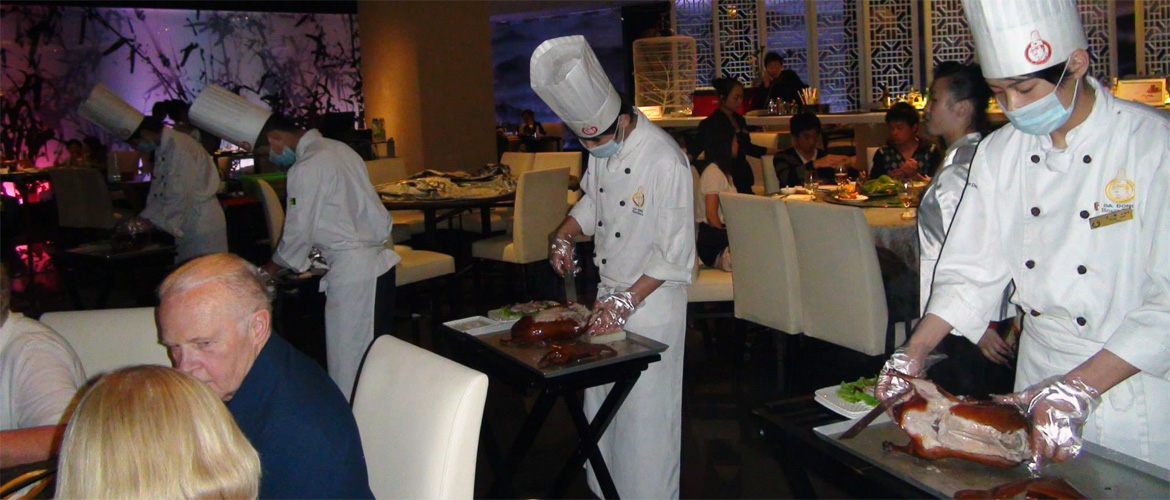
Today we enjoy a delicious dinner at a popular Peking Roast Duck restaurant. Peking Roast Duck is a famous Beijing dish prized for the thin and crispy skin with authentic versions serving mostly the skin and little meat, sliced in front of the diners.
Day 4/Sun: Beijing (B/L)
After an early breakfast we embark on a full-day excursion to the legendary Great Wall at Mutianyu, 75 km northeast of the city.
Zigzagging over 6,000 kilometres from east to west along the undulating mountains, the Great Wall was built to hold off tribal invaders from the north. As history shows, the Wall failed the Chinese rulers miserably, especially in the case of Kublai Khan who and his men swept across China from the Mongolian steppe, thus the beginning of the Yuan Dynasty (1279-1368).
Construction of the earliest sections of the Wall started in the 7th century BCE. A major renovation started with the founding of the Ming Dynasty in 1368 and took 200 years to complete. The wall we see today in Beijing is almost exactly the result of this effort.
Day 5/Mon: Beijing – Xi’an (B/L/D)
We begin our sightseeing today with a visit to a traditional hutong neighbourhood. Hutong refers to an ancient alleyway with siheyuan or ”4-sided courtyard house” on both sides. The name hutong dates back to the Yuan Dynasty (1279 – 1368 CE). According to some experts, the word originated from the Mongolian language, in which it is pronounced as hottog and means “well.” In ancient times, people tended to gather and live around wells. So the original meaning of hutong should be “a place where people live around”.
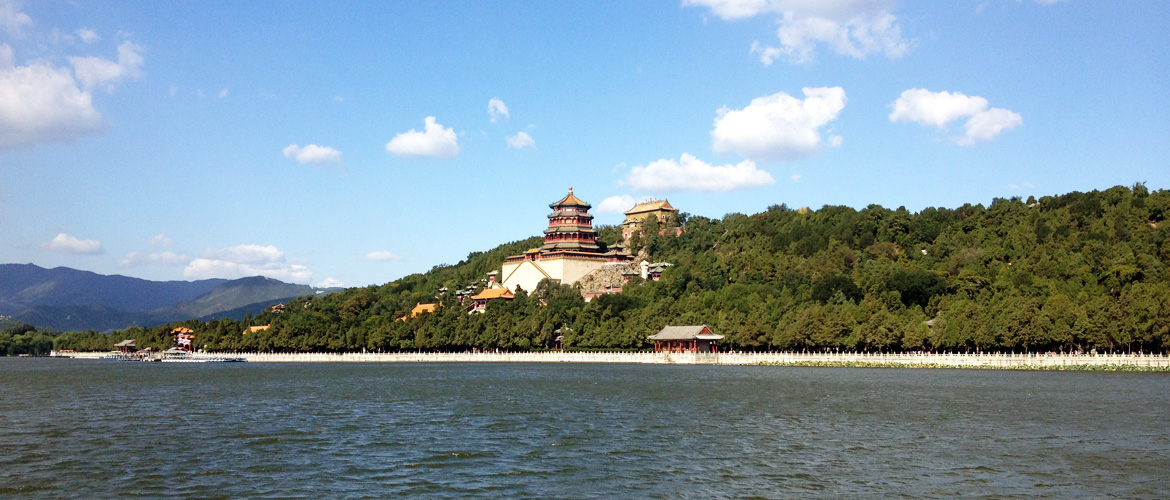
Next on our schedule is the Summer Palace, a well preserved UNESCO World Cultural Heritage Site. The imperial resort was first named Garden of Clear Ripples, which was burnt down by the allied forces of Great Britain and France in 1860 at the end of the Second Opium War (referred to as Arrow War by the British). Reconstruction started 25 years later and was completed in 1895 when the name was changed to Yi He Yuan (Garden of Good Health and Harmony). The design gives prominence to Longevity Hill, as well as Kunming Lake south of the hill. The sprawling complex covers an area of 290 hectares and the buildings inside consist of over 3,000 bays.
We travel to Xian by high-speed train (#G87, 14:00/18:23). The 4-hour-23-minute rail journey through fertile farmland dotted with villages provides the visitor with an excellent way to enjoy the beautiful countryside. The track we travel on between Beijing and Zhengzhou is part of the new 2,298 km high-speed railway linking Beijing and subtropical Guangzhou and is also the longest high-speed rail line in the world. In the past 20 years China has been on a building spree expanding the country’s rail network and upgrading existing railways. Its new high-speed rail service rivals France’s TGV and Japan’s “shinkansen” in terms of safety, speed, comfort and punctuality.
Day 6/Tue: Xi’an (B/L)
With a history going back over 3,000 years, Xi’an served as China’s capital of several ruling dynasties including the Han (206 BCE – 220 CE) and the Tang (618 – 907). It is home to the famous Terracotta Army and the eastern terminus of the ancient Silk Road – a network of trade routes connecting China proper with regions as far as the Mediterranean beginning in the Second Century BCE.
We spend the morning visiting the Terracotta Army. Built on the excavation site, the museum is located 30 km east of the city. Designed to follow the first emperor of the Qin Dynasty (221-206 BCE) into eternity, the Terracotta Army represents one of the greatest archeological discoveries of the 20th century.
After lunch we return to the city for a stroll on the ancient city wall. Declared a national treasure by the State Council in 1961, the wall (first built in 1370) encircles an area of 14 square kilometres. It runs 13.7 kilometres long and measures 12 metres in height with a thickness at the base between 15 to 18 metres.
Day 7/Wed: Xi’an – Chengdu (B/L/D)
Morning sightseeing begins at Shaanxi Provincial Museum. The modern, well-organized museum was completed in 1992 and traces the history of Xian from prehistory to the Qing dynasty (1644-1912). The extensive galleries and exhibitions offer the visitor an excellent introduction to the area that greatly improves understanding of the numerous historical sites in and around the city.
We then visit the grand mosque in the old town centre and the adjacent Muslim bazaar. The mosque was established in the 8th century and the majority of the complex was constructed in the Ming Dynasty (1368-1644). It was further expanded in the Qing Dynasty. Unlike mosques in Middle Eastern or Arab countries, this mosque is completely Chinese in style. It has neither domes nor traditional minarets.
This afternoon we ride the bullet train (G1975, 14:34/18:25) to Chengdu. Capital of populous Sichuan Province, Chengdu is an ancient city with a population of 14 million. The fertile Chengdu Plain, on which Chengdu is located, is often referred to by the Chinese “Country of Heaven”, a phrase also translated as “The Land of Abundance”. The discovery of the Jinsha archaeological site suggests the area had become the centre of the Bronze Age Sanxingdui Culture around the time of the establishment of the state of Shu prior to its annexation by Qin in 316 BCE.